
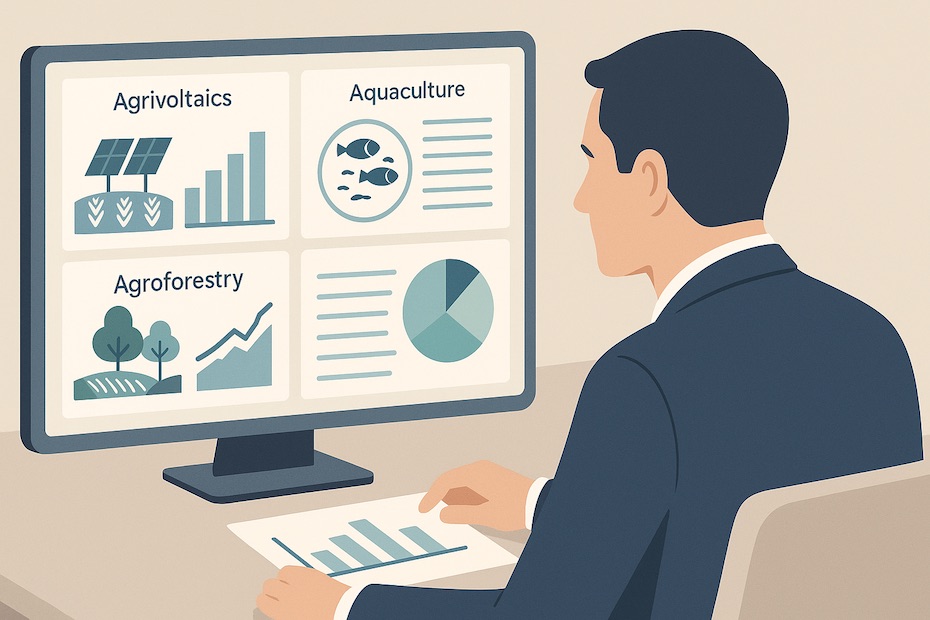
You can diversify your agriculture portfolio by investing beyond crops, exploring areas like agrivoltaics, agroforestry, carbon credits, aquaculture, and agtech infrastructure.
This article breaks down five often-overlooked agriculture investments that provide new income streams, reduce risk, and position you for long-term growth. You’ll see how each model works, what metrics to watch, and how to implement them effectively.
Investment 1: Agrivoltaics – Dual Use of Land for Energy and Farming
Agrivoltaics lets you produce crops and renewable energy on the same land by integrating solar panels above or between planting rows. The panels generate power while the crops grow underneath.
The dual-income stream is compelling: you earn from electricity sales while still harvesting your fields. Some pilot projects even show improved yields for crops grown under partial shading, as panels reduce evaporation and moderate heat stress.
The upfront cost of panels and regulatory hurdles are barriers, but the long-term returns combine predictable energy revenue with farmland productivity. For investors, agrivoltaics transforms land into a hybrid energy-agriculture asset with steady cash flow potential.
Investment 2: Agroforestry and Silvopasture – Trees as a Multi-Revenue Asset
Agroforestry integrates trees into farmland, either along borders, between crops, or in grazing systems. Silvopasture goes a step further by combining trees, livestock, and pasture.
These models create layered revenue: timber, fruit, fodder, and animal production. At the same time, trees improve soil health, reduce erosion, and stabilize microclimates. Farmers adopting agroforestry often see higher resilience to climate shifts and steadier long-term returns.
The trade-off is time. Trees require upfront investment and years to mature, but they build value continuously once established. If you take a long-term perspective, agroforestry becomes both a financial and ecological wealth builder.
Investment 3: Carbon Credits and Ecosystem Services
Carbon markets and environmental service payments allow you to monetize conservation practices. By adopting soil regeneration techniques, planting cover crops, restoring wetlands, or implementing biochar applications, you generate credits for carbon sequestration or biodiversity.
Companies and governments purchase these credits to offset emissions. Programs pay farmers either annually or based on measurable performance. This creates a recurring income stream tied not to crop yields, but to environmental benefits.
Verification and permanence are the critical hurdles here. To succeed, you must work with recognized certification bodies and maintain practices that ensure carbon stays stored over decades. Done right, carbon credits diversify your income while aligning with global sustainability trends.
Investment 4: Biological Inputs and Soil Technologies
Biological inputs like microbial inoculants, biostimulants, and biochar are transforming soil health. These inputs enhance water retention, nutrient uptake, and long-term productivity.
Investing in companies that develop or distribute these products—or in farms that adopt them—gives you exposure to one of agriculture’s fastest-growing markets. For instance, biochar improves soil fertility while also locking away carbon, making it attractive for both productivity and carbon-credit generation.
As consumer demand for sustainable farming rises, farms using biological inputs often secure premiums from buyers. This creates an investment case where better practices lead to higher market value and reduced input costs simultaneously.
Soil and Biological Investment Highlights:
- Biochar production facilities and distribution networks
- Start-ups producing microbial fertilizers or bio-stimulants
- Farms transitioning from synthetic inputs to regenerative systems
- Precision nutrient delivery technologies using nanotech
- Partnerships with carbon markets tied to soil sequestration
Investment 5: Aquaculture and Aquaponics – Farming in Water
Aquaculture, the farming of fish and seafood, is one of the fastest-growing protein industries worldwide. Rising demand for sustainable protein sources makes this an attractive sector.
Aquaponics integrates fish farming with hydroponic crop systems, creating a closed-loop cycle. Fish waste feeds plants, while plants filter water for fish. The result is two revenue streams—fish and vegetables—on a smaller footprint.
Risks include disease outbreaks, water quality issues, and infrastructure costs. But successful operations often generate higher returns per unit area compared to traditional farming. For investors, aquaculture provides entry into a global protein market that continues to outpace demand growth.
How does agtech infrastructure fit into these investments?
Beyond physical farming, you can invest in the digital backbone that supports agriculture. Agtech includes precision sensors, drone analytics, robotics, supply chain platforms, and traceability software.
These services generate recurring revenues from subscriptions, data insights, and digital transactions. Since they operate across multiple farms, they scale without exposure to specific commodity risks.
For you, investing in agtech infrastructure means capturing returns from agriculture’s digital transformation, while diversifying away from climate and yield volatility.
What risks and metrics should you track in non-crop agriculture investments?
Innovative agriculture investments require a different set of evaluation metrics than traditional crops. Pay attention to:
- Return profile: internal rate of return (IRR), yield, or cash flow timeline
- Capital intensity: upfront vs. operating costs
- Certification: regulatory requirements for carbon credits or renewable energy
- Diversification: ability to offset commodity cycles or regional climate risks
- Market demand: buyer appetite for environmental credits, renewable energy, or aquaculture products
- Technology adoption: user growth for agtech solutions
Risks include long payback periods, shifting regulations, and execution challenges. Evaluate how resilient each model is under stress scenarios.
How can you start integrating these innovative models?
The best entry point is piloting. Dedicate a fraction of your capital or land to test agrivoltaics, carbon credits, or aquaculture before scaling.
Seek partnerships with established operators or technology providers. Co-investing reduces risk while giving you access to proven expertise. For carbon or biochar projects, work with certification bodies from the outset to secure long-term income streams.
Once validated, you can expand incrementally—layering agroforestry alongside crops, scaling aquaponics facilities, or adding solar infrastructure. Over time, these investments complement traditional farming and stabilize portfolio performance.
What are innovative agriculture investments beyond crops?
- Agrivoltaics (solar + farming)
- Agroforestry and silvopasture
- Carbon credits and ecosystem services
- Biological soil inputs (biochar, microbes)
- Aquaculture and aquaponics
- Agtech infrastructure and platforms
Take Action: Diversify Beyond Crops
Relying solely on crops limits your exposure and magnifies your risk. By exploring innovative agriculture investments like agrivoltaics, agroforestry, aquaculture, carbon credits, and agtech infrastructure, you unlock new streams of value. The path forward is about integrating resilience, diversification, and sustainability into your portfolio. Choose one area, pilot it, and expand as performance proves itself. The future of agriculture belongs to those who see beyond crops.
If you’d like deeper case studies, financial models, or step-by-step guidance, visit my profile here to access more of my published work and expert insights.