
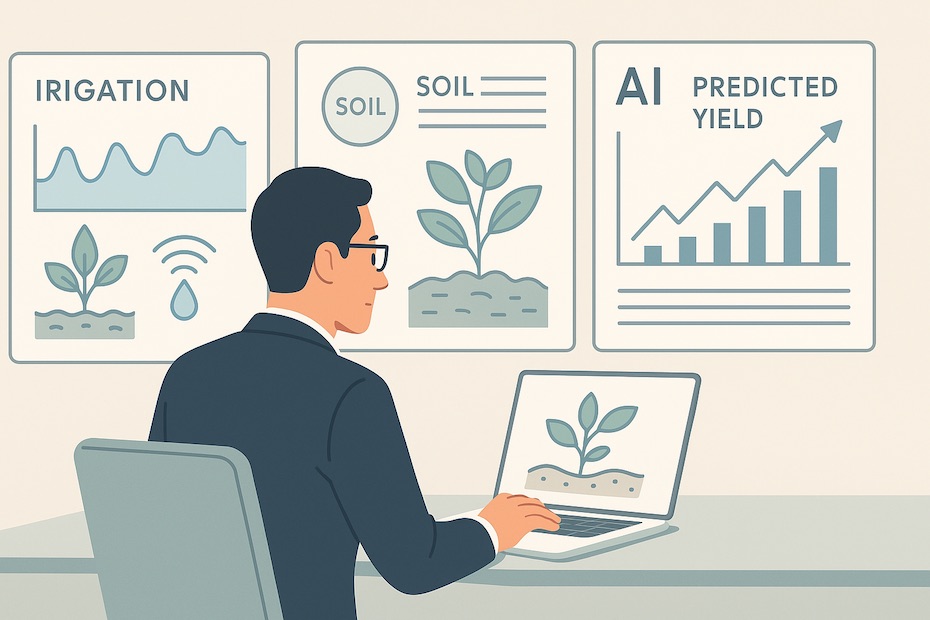
You improve crop efficiency and decision-making when you apply IoT and AI to precision agriculture. These technologies let you optimize resources, detect stress early, and raise yields.
In this article, you’ll learn how IoT sensors and AI systems work together in crop fields, what benefits they deliver, what risks you must manage, and how to implement them step by step. You’ll also see metrics for success and real-world applications that make a data-driven farm a profitable reality.
What is precision agriculture, and why are IoT and AI essential?
Precision agriculture means managing fields using real-time data to adjust inputs like water, fertilizer, and pesticides exactly where and when they’re needed. IoT devices provide that raw data, and AI makes it actionable.
You use IoT sensors to measure soil moisture, nutrient levels, and climate variables, while AI analyzes the feed to highlight variability. This combination lets you address stress zones, balance input use, and create consistent yields.
The strength of precision agriculture comes from this feedback loop: sensors track, AI interprets, and systems apply adjustments automatically or with your oversight.
How does IoT function in crop management?
IoT in agriculture builds a digital infrastructure of sensors, weather stations, and smart equipment that keeps you connected to your fields 24/7.
Soil probes track moisture, temperature, and electrical conductivity, while weather nodes monitor humidity, rainfall, and solar radiation. Canopy sensors detect crop vigor and leaf wetness—indicators for disease risk.
The data flows through low-power, wide-area networks like LoRaWAN or NB-IoT, enabling real-time monitoring even in remote areas. You also integrate actuators such as automated irrigation valves that respond instantly to IoT signals.
What role does AI play in smarter decision-making?
AI is the brain that converts IoT data into predictions, alerts, and automated recommendations.
You can use machine learning to forecast yields, detect pests or diseases, and predict irrigation demand. Computer vision models applied to drone or satellite imagery identify stress before the human eye can see it.
Predictive models also combine historical data with current weather patterns to optimize spraying schedules or nutrient application. This shifts your farm management from reactive to proactive, saving both time and resources.
What benefits do IoT and AI deliver in precision agriculture?
The key advantage is resource optimization. You reduce waste by applying water, fertilizers, and pesticides precisely where needed, cutting both costs and environmental impact.
You also gain early stress detection. AI alerts you to anomalies like disease onset or nutrient deficiency before they damage output.
Other benefits include:
- Higher yields through consistent management of micro-zones
- Lower labor costs due to automation and remote monitoring
- Greater predictability in harvest volumes and quality
These improvements compound over time, lifting profitability and strengthening your competitive edge.
What risks and challenges should you expect?
Adopting IoT and AI comes with hurdles that you must anticipate and manage.
Upfront investment can be significant, covering sensors, connectivity, and AI systems. Smaller farms often hesitate without clear ROI forecasts. Data quality is another issue; faulty or missing sensor readings can weaken AI accuracy.
Cybersecurity risks also apply. Any connected device is a potential entry point, so you must secure IoT networks. Additionally, AI usability remains a barrier; models need regular training, and farm staff require straightforward interfaces to adopt them successfully.
What steps should you take to implement IoT and AI?
A phased approach minimizes risk and accelerates adoption.
Start with a pilot area representing your farm’s variability. Deploy soil sensors, install a local weather station, and collect data over one season. Use that dataset to train initial AI models.
Expand gradually by connecting models to irrigation systems, fertilizer injectors, or spraying equipment. Validate predictions against field reality, refine the models, and only then scale to cover more acres.
To build confidence, measure outcomes such as water saved, yield gains, and input reductions. These tangible results reinforce ROI and justify further expansion.
What are the best use cases for IoT and AI in farming?
Use cases vary by crop type and region, but common applications prove the technology’s value across the board.
- Variable rate irrigation: Sensors detect dry zones, and AI triggers only the needed irrigation lines.
- Disease detection: Drones capture aerial images, and AI identifies fungal infection before spreading.
- Yield prediction: By combining field sensor data with weather and historical yields, AI forecasts output weeks in advance.
- Autonomous equipment: Robots or smart sprayers guided by AI apply pesticides only where needed, reducing chemical load.
These use cases show how precision systems can expand from monitoring to automation—giving you more leverage over limited resources.
What are the essentials of precision agriculture using IoT and AI?
- IoT sensors track soil, crop, and weather data
- AI analyzes patterns and provides predictions
- Automated systems adjust irrigation, spraying, and nutrient inputs
Take Action to Build Smarter Farming Systems
Precision agriculture powered by IoT and AI gives you sharper control over your fields, reduces waste, and secures consistent yield improvements. Start with pilots, scale cautiously, and track performance metrics closely. By integrating technology with disciplined management, you can position your farm as both efficient and future-ready.
Want to see how others are scaling precision systems? Visit my profile here for practical case studies and expert resources.