
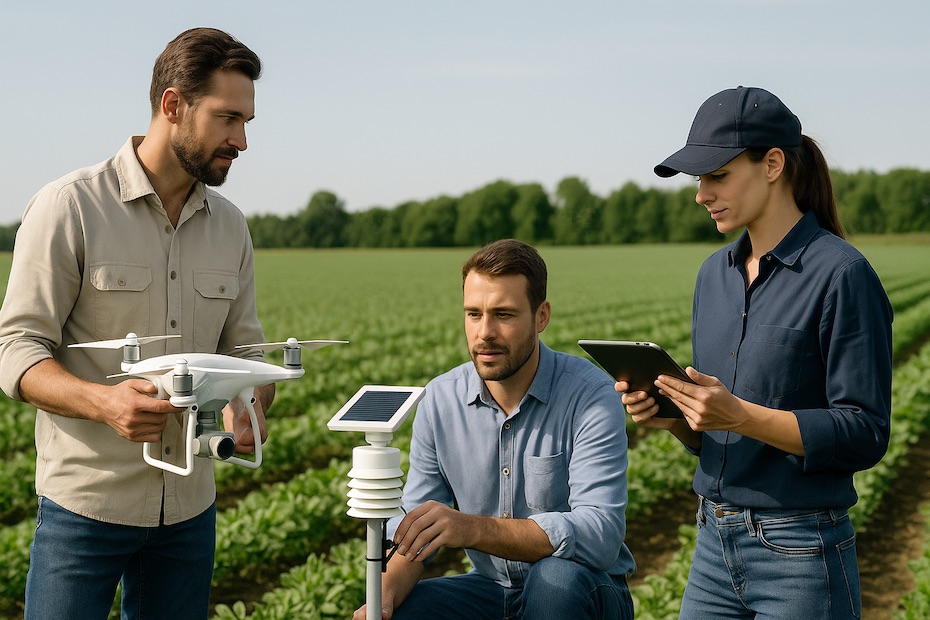
You should watch emerging agtech startups now because they’re redefining how food is grown, managed, and marketed through data, automation, and biology.
This article identifies the most promising companies, core innovation categories, and investment trends driving the next generation of agricultural technology. You’ll learn how these startups are changing real-world farming operations and where opportunities lie for you as an agribusiness investor or professional.
What’s Fueling the AgTech Startup Boom in 2025?
AgTech startups are growing at an accelerated pace due to global demand for sustainable, data-driven, and efficient food systems. With agricultural output needing to increase by more than 60% by 2050, according to the FAO, innovation is no longer optional — it’s operational necessity.
In 2025, three forces are propelling the boom: AI adoption, supply-chain transparency, and climate resilience. Startups are combining machine learning with biological engineering to improve crop yields, automate labor, and verify carbon outcomes. According to AgFunder’s 2024 Global AgriFoodTech report, private agtech investment surpassed $13.3 billion in 2024, showing renewed investor confidence in next-generation agriculture.
Whether you’re managing farmland, leading a food enterprise, or investing in innovation, monitoring this startup surge gives you foresight into which technologies will set the competitive benchmark for the next decade.
Precision Data and AI Startups Revolutionizing Decision-Making
Data-driven farming is no longer experimental — it’s the foundation of modern agriculture. AI platforms, IoT sensors, and predictive models now drive planting schedules, fertilizer optimization, and water management.
Cropin, an India-based SaaS startup, uses AI and satellite imagery to deliver real-time agronomic insights across over 30 million acres in 100+ countries. It enables you to analyze soil, climate, and crop health instantly, cutting waste and improving yield predictability.
Similarly, Gamaya, a Swiss company using hyperspectral imaging drones, allows growers to detect nutrient deficiencies or pest outbreaks before they become visible. By integrating precision imaging with machine learning, it provides actionable intelligence — not just raw data.
If you’re running a commercial farm, AI platforms like these let you make precise decisions without overreliance on manual scouting or outdated averages. This is where “smart farming” moves from theory to measurable ROI.
Automation and Robotics: Replacing Labor Gaps with Smart Machines
Labor shortages and rising operational costs have made automation a top priority for growers. Robotics startups are filling that gap with specialized machinery that handles repetitive and resource-intensive farm work.
FarmWise, a California-based startup, has built autonomous weeding robots that reduce herbicide use by up to 90%. Each machine uses computer vision to identify weeds and remove them mechanically — no chemicals required.
In the greenhouse sector, Iron Ox combines hydroponics with robotic arms to move and monitor plants automatically, improving consistency and reducing resource waste. This integration of robotics and controlled-environment agriculture (CEA) represents the next leap toward self-regulating farms.
The impact is clear: automated machinery cuts dependency on seasonal labor, enhances precision, and enables you to manage larger acreage with fewer hands — translating directly to higher profit margins.
Biologicals and Regenerative Input Startups Transforming Soil Health
Chemical dependency has long been a hidden cost of high-yield agriculture. Biological input startups are solving that by engineering natural alternatives to fertilizers, pesticides, and soil conditioners.
Ohalo Genetics, backed by funding from Breakthrough Energy Ventures, accelerates plant breeding cycles using genetic mapping and AI-assisted selection. Their “Boosted Breeding” model reduces crop development time from a decade to a few years, allowing faster adaptation to climate variability.
Meanwhile, Pivot Bio and Indigo Ag — two biological input pioneers — continue scaling microbial nitrogen-fixation products that replace synthetic fertilizers. Farmers using these biofertilizers report improved soil structure, reduced runoff, and better yield resilience.
If you manage a farm portfolio or invest in agricultural sustainability, these startups show where biology and profitability intersect — a key theme for the next green revolution.
Supply Chain and Market Access Platforms Empowering Farmers
Technology isn’t just transforming how crops are grown — it’s changing how they reach markets. Agtech startups are bridging the gap between growers, distributors, and retailers through transparent, data-rich supply chains.
Fashol, a Bangladesh-based agri-supply startup, connects smallholder farmers directly with urban retailers. Its platform streamlines aggregation, logistics, and quality assurance, reducing middlemen costs by over 25%.
U.S.-based Bushel, on the other hand, digitizes grain transactions, allowing producers and elevators to trade, settle payments, and access pricing data seamlessly. With more than 120,000 producers onboarded, it’s redefining how the commodity market functions.
By adopting these systems, you ensure traceability — something that’s becoming a regulatory and consumer expectation. Moreover, digital marketplaces unlock premium pricing for verified, sustainable produce, directly improving revenue per acre.
Sustainability and Carbon-Tech Startups Monetizing Climate Action
The agricultural carbon market is no longer niche — it’s a multi-billion-dollar sector in development. Startups are enabling you to generate, verify, and sell carbon credits by quantifying soil carbon and regenerative practices.
Regrow Ag, one of the most advanced carbon measurement startups, uses remote sensing and modeling to verify carbon sequestration in soil. It partners with global brands like Kellogg’s and General Mills to certify regenerative sourcing.
Another emerging player, Nori, operates a blockchain-based carbon credit marketplace that directly connects farmers with corporate buyers. By adopting cover crops or reduced tillage, you can generate verified credits and turn sustainability into a secondary income stream.
These carbon-tech platforms don’t just check ESG boxes — they create financial pathways for climate-smart agriculture.
AgFinTech: Financing the Future of Farming
Farm finance has traditionally been fragmented, but fintech innovation is changing that. AgFinTech startups now offer tailored credit, crop insurance, and risk-hedging platforms powered by data analytics.
ProducePay provides working capital for growers, processors, and distributors while giving visibility into market prices and cash flow. Since its inception, it has financed over $4 billion in fresh-produce transactions.
Similarly, DeHaat, operating across India, integrates farm advisory, inputs, and credit within one digital ecosystem for smallholders — a sector historically underserved by banks.
By leveraging digital finance platforms, you gain access to transparent capital pipelines that reward operational performance rather than collateral value — making agricultural growth more inclusive and scalable.
Controlled-Environment and Vertical Farming Startups Scaling Year-Round Production
As arable land shrinks, controlled-environment agriculture (CEA) and vertical farming startups are offering an answer: more food, less land.
Companies like Plenty, Bowery Farming, and Infarm are building automated, data-controlled farms that produce crops 24/7 in urban warehouses. Plenty’s recent expansion into the Middle East illustrates the scalability of this model — providing year-round local food with 95% less water use.
While vertical farming still faces high capital costs, advancements in LED efficiency, AI-driven nutrient control, and renewable-powered systems are improving ROI. If you’re investing in next-generation infrastructure, this segment represents one of the highest long-term growth trajectories in global agritech.
The data supports it — the vertical farming market is projected to exceed $33 billion by 2032 (Allied Market Research, 2024).
How to Evaluate and Engage with AgTech Startups Effectively
Before you invest or integrate new agtech, you must assess operational readiness and measurable ROI. Look beyond hype by reviewing these core evaluation areas:
- Field validation: Has the technology been tested in full-season, commercial-scale trials?
- Quantified performance: Does the startup provide verifiable data on cost reduction or yield improvement?
- Scalability: Can the model adapt to your crops, region, and resource availability?
- Team credibility: Are founders backed by agronomists, data scientists, or industry veterans?
- Revenue model: Service-based models (SaaS or subscription) often reduce risk compared to hardware-only startups.
Professional investors use these same filters to separate technology promise from market-ready performance. When you apply this discipline, you invest in solutions — not prototypes.
What are the top agtech startups to watch in 2025?
- Cropin – AI-powered farm intelligence
- FarmWise – Robotic weeding automation
- Ohalo Genetics – Accelerated plant breeding
- Regrow Ag – Carbon measurement platform
- Fashol – Digital agri-supply network
Lead the Future of Smart Agriculture
You now have a clear view of the technologies and startups shaping agriculture’s next chapter — from robotics to carbon credits. The future of farming will belong to those who combine operational experience with data precision and technological foresight. Start piloting solutions, measure ROI, and position your agribusiness to outperform through innovation.
To explore detailed analyses, investment strategies, and startup breakdowns, visit my website — where I share deep-dive content on agtech, agrifinance, and sustainable innovation for forward-thinking professionals.