
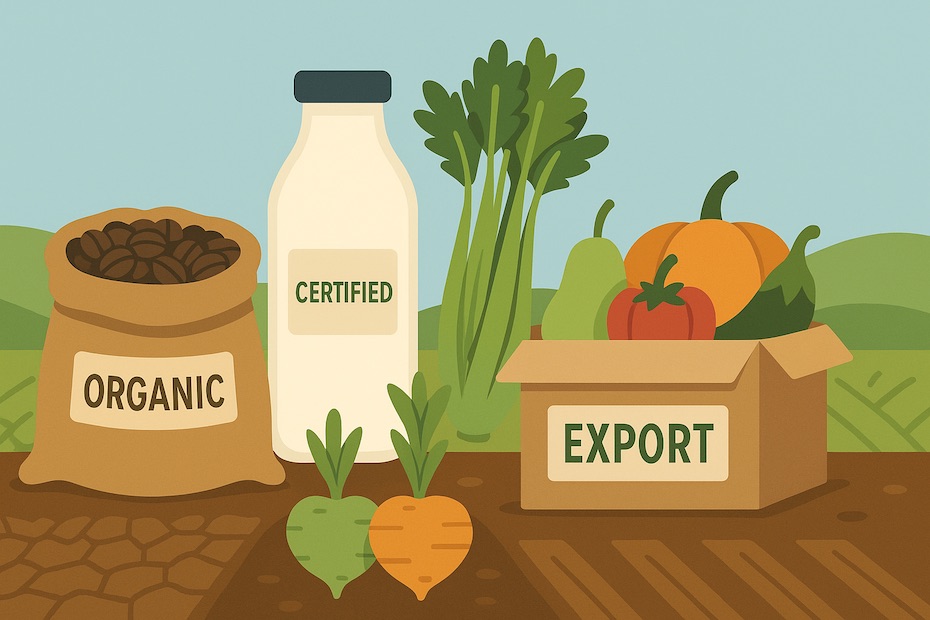
Eco-labels offer measurable financial returns when applied strategically to farming operations. They enhance market access, improve price premiums, and reduce long-term risk in supply agreements.
In this article, you’ll explore whether sustainability certifications are worth the investment. You’ll learn which certifications matter most, how they influence pricing and market perception, and what steps to take to get certified without losing operational focus. This guide is grounded in global market data and practical farm business experience.
What Are Sustainability Certifications in Agriculture?
Sustainability certifications in farming are third-party verifications that a product or process meets defined environmental, social, or ethical standards. These labels cover water conservation, biodiversity, carbon emissions, and labor practices.
The most widely used include USDA Organic, Rainforest Alliance, Fair Trade, GlobalG.A.P., and Certified Naturally Grown. Each one targets different supply chain priorities. For instance, GlobalG.A.P. compliance is essential for EU exports, while Fair Trade certification matters to ethically driven North American buyers. Getting certified usually requires audits, documentation, and compliance with specific standards tied to farm inputs, labor practices, and traceability.
The certification landscape can be overwhelming without clarity on market targets. You need to match your farm’s operational structure with the certification that drives the highest returns in your buyer segment.
Do Eco-Labels Really Increase Farm Profitability?
Yes, eco-labels can boost profitability when they unlock premium markets or long-term contracts. But the returns depend heavily on certification alignment with your target buyer’s values.
A 2024 report from the International Trade Centre showed organic produce receives an average 30% premium over conventional crops. In markets like Germany, Denmark, and the Netherlands, that number often exceeds 50%. Retailers in these countries have aggressive sourcing goals tied to certified supply chains—offering price premiums and longer procurement terms to certified producers.
However, not all certifications deliver equal ROI. Low consumer recognition or high compliance costs can dilute value. For smallholders and mid-sized farms, cost-benefit analysis is critical. Success hinges on integrating certification into a broader market positioning strategy rather than using it as a badge of sustainability alone.
How Do Certifications Influence Consumer Trust and Retail Access?
Certifications function as proxies for quality and ethics in the retail space. Consumers use them to identify brands or producers they perceive as safer, healthier, or more socially responsible.
Retailers—particularly in the EU and North America—now require some form of sustainability labeling in order to list farm products. Whole Foods, Aldi, and Carrefour have all made public commitments to source a growing percentage of produce and meats from certified suppliers. Distributors rely on certifications to manage traceability, which supports their own ESG compliance.
In this supply-driven dynamic, eco-labels give you leverage to negotiate better distribution deals or win tenders where non-certified producers are filtered out early. The trust is not just with end consumers—it’s deeply embedded in wholesale procurement criteria.
Which Certifications Offer the Best ROI for Small and Mid-Sized Farms?
If you’re managing a small or mid-sized farm, three certifications consistently offer the highest return on investment:
- USDA Organic: Especially valuable for high-margin crops in U.S. domestic markets.
- Fair Trade Certified: Offers price floors and community development premiums on products like coffee, cacao, and tropical fruits.
- GlobalG.A.P.: Vital for accessing EU-based buyers or supermarket chains requiring full traceability and food safety compliance.
While certifications like Regenerative Organic or Demeter are gaining ground, they currently cater to niche segments. Your ROI depends on whether the certification opens distribution channels that pay for your operational shift.
What Is the Cost and Time Commitment to Get Certified?
The cost of certification ranges widely depending on your location, the certifying body, and farm size. For USDA Organic, initial inspection and audit fees can run $750–$3,000, with annual renewals between $500–$1,500.
Fair Trade and Rainforest Alliance involve both annual audits and internal monitoring systems, adding administrative overhead. Timewise, the certification process typically requires 6 to 18 months of preparation, with documentation of input use, labor practices, and harvest procedures.
Here’s what your investment generally includes:
- Application and audit fees
- Internal recordkeeping or staff training
- Infrastructure upgrades (if needed)
- Time allocation for compliance monitoring
Grants, cooperatives, or government cost-sharing programs may offset up to 75% of these expenses, especially for organic or conservation-based certifications.
How Can You Use Eco-Labels to Differentiate in Commodity Markets?
When your product competes in a commodity market—like soy, corn, or beef—certification lets you segment yourself from price-only competitors. It builds a narrative buyers can trust and justify premium payments for.
Take the example of organic soybean producers in Brazil. While conventional soy was trading below $500/ton in 2023, certified organic soy exceeded $800/ton in export markets. Similar differentials apply to certified palm oil, cotton, and tropical fruit.
Eco-labels also serve as the foundation for branding. Whether you sell directly to consumers or supply food manufacturers, certifications validate your ESG story and give buyers the documentation they need to promote sustainability through their own supply chains.
What Are the Most Common Pitfalls When Pursuing Certification?
Failure to plan certification within existing production cycles is a top mistake. If you begin compliance changes mid-season, you’ll miss documentation requirements and likely fail audits.
Another common pitfall is choosing certifications with little market demand in your sales region. Certification only pays off if it creates market access, price premiums, or long-term purchasing commitments.
You should also avoid underestimating administrative burdens. Most certifiers require monthly or seasonal data uploads, production records, and self-audits. Without a clear data management system, farms fall out of compliance and lose their credential.
Do eco-labels help farmers financially?
- Yes, when tied to buyer demand
- Can boost prices 20–50%
- Enhance long-term contracts
- Improve supply chain access
- Require upfront investment and tracking
In Conclusion
When executed strategically, eco-labels do pay off—both in immediate premiums and long-term buyer relationships. They’re no longer just “nice to have”; they’re fast becoming supply chain prerequisites. Your decision should be guided by buyer demand, certification ROI, and operational feasibility. When aligned, sustainability certifications can make your farm business more resilient, profitable, and future-ready.
If you found this article insightful, you may also enjoy exploring the work of other thought leaders in sustainability and innovation.
👉 Visit: mystrikingly