
The backbone of our global food system, the agricultural sector, faces a pressing and perennial challenge that threatens food security, production efficiency, and economic sustainability: the labor shortage. This issue is far from trivial; it is a critical bottleneck that compromises the ability of farms to plant, cultivate, and harvest crops, directly impacting the availability and price of food worldwide. As we delve into this topic, we uncover a multifaceted dilemma rooted in demographic shifts, economic disparities, and technological gaps.
At the heart of agriculture’s workforce woes are several key factors, each contributing to the dwindling pool of available labor. Urban migration stands out as a significant driver, with younger generations moving to cities in search of better education, higher wages, and improved living conditions, leaving rural areas and farms understaffed. Compounding this issue is the aging farmer demographic, with a notable portion of the agricultural workforce nearing retirement and few stepping in to fill their boots. Additionally, the allure of higher wages and more comfortable working conditions in other sectors makes agriculture a less attractive option for the labor force. These challenges are not just local but global, affecting farms from the sprawling fields of the Midwest to the rice paddies of Southeast Asia.
This article aims to move beyond merely outlining the problems plaguing the agricultural sector to shining a light on actionable, innovative solutions and policy recommendations that can address these labor challenges head-on. By exploring advancements in technology, such as robotics and artificial intelligence (AI), alongside strategies for revitalizing rural economies and reforming labor policies, we seek to offer a roadmap towards a more sustainable and resilient agricultural workforce. Our journey will take us through cutting-edge innovations, global mobility initiatives, and efforts to make agricultural jobs more appealing and accessible. Join us as we navigate through these solutions, aiming to sow the seeds for a future where the labor of the land meets the demands of the growing global population.
The Current Landscape of Agricultural Labor
The global agricultural sector is at a crossroads, grappling with a labor shortage that threatens to undermine food production and security. This shortage is not a new issue, but it has been exacerbated in recent years by a combination of socio-economic, demographic, and technological factors. Globally, statistics paint a concerning picture: regions that are heavily reliant on agriculture for their livelihoods are experiencing significant gaps in their workforce, leading to unharvested fields, increased food prices, and economic strain on communities that are already vulnerable.
Factors such as urban migration have significantly contributed to this problem. Younger individuals, seeking opportunities for a better life, are moving away from rural areas and into cities. This urban migration is leaving a void in the agricultural workforce, one that is difficult to fill given the sector’s reputation for hard labor and low pay. Moreover, the aging demographic of farmers further complicates the issue. With a significant portion of the agricultural workforce approaching retirement age, there’s an urgent need for new blood to carry forward the mantle of farming. However, the appeal of higher wages and more comfortable working conditions in other sectors draws potential labor away from agriculture, exacerbating the labor shortage.
Innovative Solutions to Agricultural Labor Shortages
In the face of these challenges, the agricultural sector is turning to innovation and policy reform to bridge the labor gap. Technological advancements, such as robotics, drones, and artificial intelligence (AI), are emerging as pivotal solutions. These technologies offer the promise of supplementing human labor on farms, performing tasks ranging from planting and weeding to harvesting and processing. The adoption of such automation helps address the labor shortage. Also increases efficiency and reduces the physical toll on human workers.
Revitalizing rural economies is another critical strategy for attracting and retaining agricultural labor. By improving wages, offering benefits, and investing in community development, the agricultural sector can make rural living and farming careers more appealing to younger generations. This approach requires a concerted effort from governments, businesses, and communities to create a sustainable ecosystem that supports agricultural workers and their families.
Furthermore, global mobility and labor policies present a viable avenue for filling labor gaps. By easing immigration policies for agricultural workers and establishing international labor agreements, countries can create a more dynamic and flexible workforce that meets seasonal and regional demands.
These innovative solutions, grounded in technology, economic reform, and policy flexibility, offer a beacon of hope for solving agriculture’s workforce woes. By embracing these strategies, the agricultural sector can pave the way for a more efficient, sustainable, and resilient future, ensuring that the labor of the land continues to feed the world amidst changing global dynamics.
Attracting and Retaining Agricultural Workers
Creating a Positive Work Environment
A positive work environment is foundational to retaining a skilled workforce and attracting new talent. Improving workplace conditions goes beyond physical enhancements to include fostering a culture of respect, recognition, and safety. Employers can achieve this by implementing regular feedback mechanisms, recognizing outstanding work, and ensuring that workers have access to necessary safety equipment and training. Additionally, providing amenities that improve the daily lives of workers, such as comfortable resting areas and clean facilities, can make a significant difference in job satisfaction and retention.
Investing in Training and Development
Investing in the training and development of agricultural workers is crucial for enhancing productivity and adapting to technological advancements in the sector. Offering educational programs that cover the latest farming techniques, technology use, and sustainability practices can upskill workers and increase their value to the farm. Moreover, creating pathways for career advancement within the agricultural sector motivates employees. Also helps in cultivating a more knowledgeable and dedicated workforce.
Promoting Agriculture as a Career Path
Changing perceptions of agricultural jobs is vital in attracting a new generation of workers. This can be achieved through marketing strategies that highlight the sector’s technological advancements, sustainability efforts, and its critical role in global food security. Showcasing the diversity of careers within agriculture, from scientific research and engineering to business and technology, can appeal to a wide range of interests and skills. Engaging with educational institutions to provide hands-on learning experiences and internships can also spark interest in agriculture among students.
Navigating Through Labor Shortages: A Multifaceted Strategy
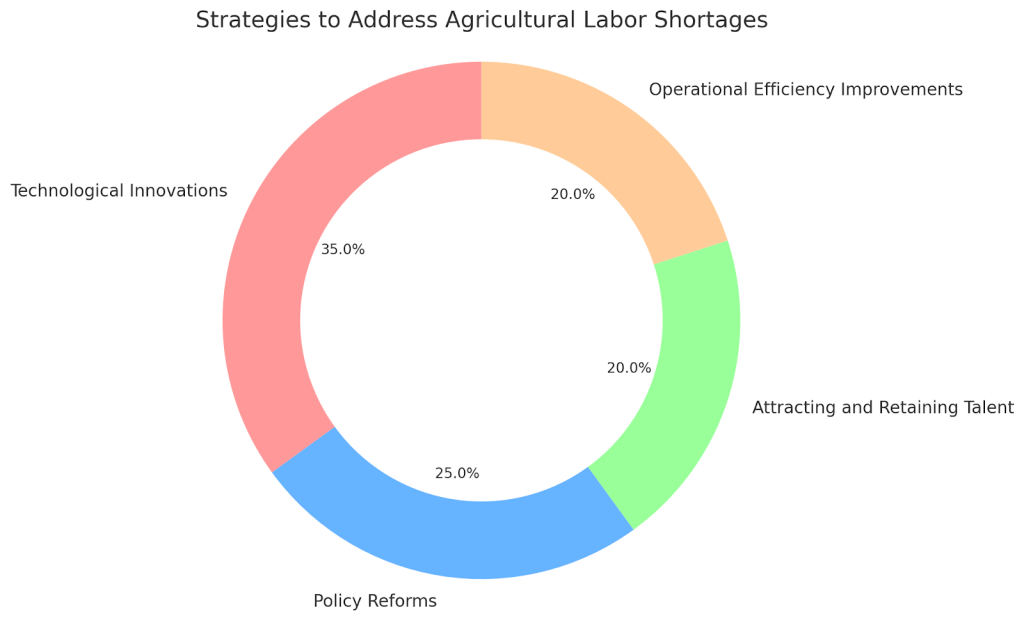
The agricultural sector is innovatively tackling labor shortages by leveraging a blend of technological advancements, policy reforms, operational improvements, and initiatives to attract and retain talent. This concerted approach underscores the complexity of the challenge and the diverse strategies required to address it effectively.
Technological Innovations take the forefront, with robotics, AI, and automation poised to revolutionize farming practices, reducing the dependency on manual labor while increasing efficiency and productivity.
Policy Reforms are crucial in creating a supportive framework that eases the recruitment and employment of seasonal and temporary workers, ensuring farms have access to a flexible and reliable workforce.
Efforts to Attract and Retain Talent focus on making agriculture a more appealing career choice through better wages, incentives, and creating a positive work environment that values safety, recognition, and professional growth.
Operational Efficiency Improvements are about making farming operations more streamlined and less labor-intensive, through practices such as no-till farming and sharing labor pools among local producers.
By embracing this holistic strategy, the agricultural sector can mitigate the impact of labor shortages, ensuring its sustainability and capacity to meet the global food demand. This approach not only addresses immediate workforce challenges but also sets the foundation for a resilient, efficient, and technologically advanced agricultural future.
Top 5 Technological Innovations Revolutionizing Agricultural Labor
Technological innovations are transforming the agricultural sector, making it more efficient, sustainable, and attractive as a career choice. Here are the top five technologies revolutionizing agricultural labor.
1. Precision Farming Tools
Precision farming tools, including GPS and IoT devices, are at the forefront of agricultural innovation. These technologies enable farmers to monitor crop health, soil conditions, and weather patterns in real time, optimizing farming practices and reducing the need for manual labor. Precision farming leads to more efficient use of resources, higher yields, and a reduced environmental footprint.
2. Robotics in Harvesting
Robotics are changing the landscape of harvesting by performing labor-intensive tasks with precision and efficiency. Robotic systems can pick, sort, and pack produce faster and more accurately than human labor, reducing physical strain on workers and increasing productivity. These systems are particularly valuable during peak harvest seasons when labor shortages are most acute.
3. Drones for Monitoring and Spraying
Drones have become an invaluable tool for crop monitoring, pest control, and targeted spraying. By providing a bird’s-eye view of fields, drones can quickly identify problem areas, allowing for rapid responses to pest infestations or disease outbreaks.
4. AI and Machine Learning for Crop Management
Artificial intelligence and machine learning are revolutionizing crop management by predicting crop health, optimizing yield, and automating decision-making processes. These technologies analyze data from various sources, including satellites and on-farm sensors, to provide actionable insights that help farmers make informed decisions about planting, watering, and harvesting.
5. Wearable Technology for Farm Workers
Wearable technology is enhancing the safety and productivity of farm workers through health monitoring and operational guidance. Devices such as smartwatches and fitness trackers can monitor vital signs and alert workers to potential health issues, while augmented reality headsets can provide real-time information and instructions, improving efficiency and reducing errors.
The Future of Work in Agriculture
The agricultural sector stands on the brink of a transformative era, with shifting demographics, technological advancements, and a growing emphasis on sustainability reshaping the future of work in this vital industry.
Shifting Demographics and the Role of Youth
The engagement of younger generations in agriculture is critical for the sector’s sustainability and growth. Technology and innovation are key drivers in attracting youth to agriculture, showcasing the industry as a vibrant, technologically advanced, and rewarding field. By integrating digital tools, robotics, and artificial intelligence into farming practices, agriculture becomes appealing to tech-savvy individuals who can lead the charge in modernizing farming techniques.
Sustainability and Labor Practices
Sustainable farming practices are becoming increasingly important in attracting and retaining workers in the agricultural sector. Environmentally conscious workers are drawn to farms that prioritize ecological balance, use resources efficiently, and minimize their carbon footprint. Implementing sustainable practices, such as organic farming, conservation agriculture, and precision farming, can help farms stand out as desirable workplaces for individuals passionate about environmental stewardship. Moreover, fair labor practices and equitable treatment of workers are essential in creating a positive and ethical work environment that fosters loyalty and commitment.
The Global Perspective on Agricultural Labor
A global perspective on agricultural labor reveals a diverse array of strategies and challenges across different countries. In some regions, innovative policies and programs are successfully addressing labor shortages by facilitating access to education, training, and technology for agricultural workers. In others, collaborations between governments, NGOs, and the private sector are paving the way for improved labor mobility and worker rights. Learning from these varied approaches can offer valuable insights into developing comprehensive strategies that address the unique needs of the agricultural workforce worldwide.
FAQs on Agricultural Labor Solutions
How can technology specifically address labor shortages in agriculture?
Technology can address labor shortages by automating repetitive tasks, improving efficiency, and reducing the physical demands of farming. Innovations such as drones, robotic harvesters, and precision agriculture tools can perform tasks ranging from planting and weeding to harvesting and data analysis, allowing farms to operate more effectively with fewer workers.
What are the most effective policies to support agricultural workers?
Effective policies to support agricultural workers include those that ensure fair wages, safe working conditions, and access to healthcare and education. Additionally, policies promoting skill development and technological training can help workers transition into more specialized roles within the sector, enhancing their productivity and job satisfaction.
Can small-scale farms compete with larger agribusinesses in attracting labor?
Small-scale farms can compete by focusing on niche markets, offering competitive wages, and creating a strong community culture. Emphasizing the benefits of working on a smaller scale, such as closer relationships with employers and a greater sense of contribution to the farm’s success, can also attract workers.
What role does education play in solving agriculture’s workforce woes?
Education plays a crucial role by equipping individuals with the knowledge and skills needed to succeed in modern agriculture. Offering courses in agricultural science, technology, and business can prepare the next generation of farmers and agricultural professionals to address the challenges of the 21st century.
In Conclusion
The agricultural sector’s future hinges on its ability to adapt to changing demographics, embrace technological innovation, and implement sustainable practices. The discussions around attracting youth, promoting sustainability, and learning from global labor trends underscore the importance of a multi-faceted approach to agricultural labor challenges. By integrating technology, fostering fair and sustainable labor practices, and encouraging education and skill development, we can build a resilient and vibrant agricultural workforce.