
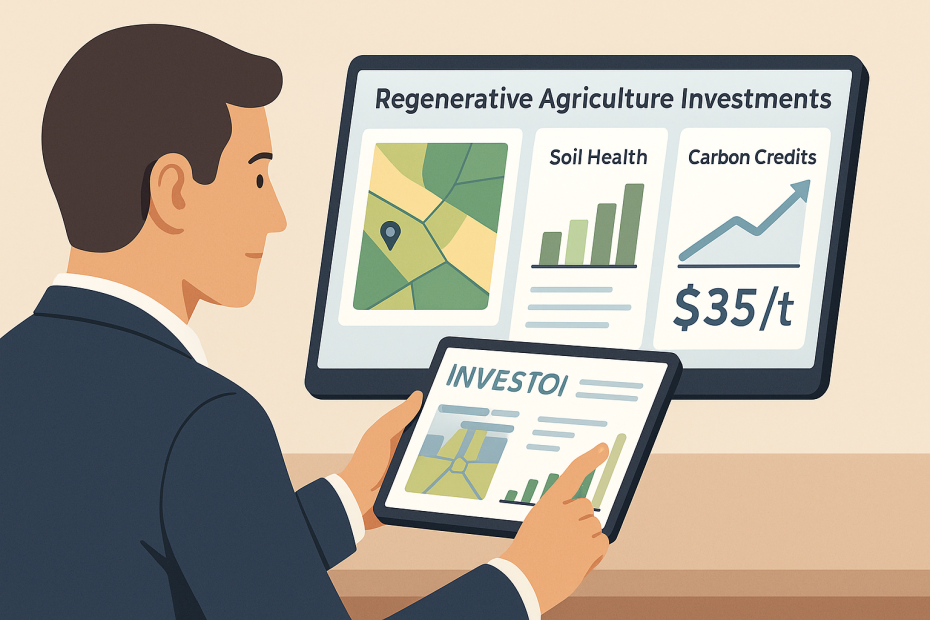
You profit from regenerative farming by investing in farmland, funds, and agricultural technologies that increase yields, cut input costs, and create new revenue streams through ecosystem services like carbon credits.
This guide walks you through the financial logic of sustainable agriculture investments. You’ll learn how regenerative farming boosts profitability, strengthens resilience, and expands opportunities across farmland, funds, and ecosystem markets.
What’s driving investor interest in regenerative agriculture?
Investor demand for regenerative farming has surged due to its strong returns and resilience. In Q1 2025, regenerative agriculture raised over $1.17 billion in new capital, largely from venture funds and acquisitions.
Institutions are positioning early. Microsoft invested in Farmland LP, a regenerative-focused operator with annual returns averaging 10.5%. That combination of sustainability and stable returns is attracting both corporate and institutional capital.
This trend reflects confidence that regenerative agriculture is more than an environmental strategy—it’s a viable asset class that strengthens portfolios.
What financial benefits does regenerative farming offer?
Regenerative farming boosts profits by lowering costs and increasing yields. Studies show soil-health practices can improve profits and yields by up to 25%. For operators, that translates into reduced reliance on fertilizers and pesticides, as natural soil fertility improves.
At scale, regenerative agriculture demonstrates strong ROI. A Boston Consulting Group report projected potential returns of 15–25% once farms adopt regenerative practices system-wide. For investors, this level of profitability matches or exceeds traditional farmland.
You capture value through both short-term efficiency gains and long-term appreciation of well-managed farmland assets.
How do ecosystem services add new revenue streams?
Regenerative systems monetize soil health through ecosystem services. By building organic matter, farmland sequesters carbon, retains water, and reduces erosion—all measurable and tradable benefits.
Carbon credit markets now allow you to generate revenue for each ton of carbon captured. Platforms like Agreena help farmers verify and sell credits, aligning ecological benefits with cash flow.
As companies increase demand for verified carbon offsets, investors in regenerative land stand to profit from these parallel revenue streams, beyond crop sales alone.
What resilience advantages come with regenerative practices?
Beyond profitability, regenerative systems deliver resilience. Healthy soils hold water longer, reducing irrigation needs and buffering against drought. Crop diversification spreads risk and lowers dependence on single commodities.
Analysis of diversified regenerative farming shows long-term gains compound dramatically. Over 20 years, ecosystem services and profitability combined to deliver increases exceeding 2,800%. That kind of resilience strengthens returns while reducing downside exposure.
When you invest in regenerative farming, you invest in systems built to endure volatility.
What challenges should you expect when investing?
Transition costs present a barrier. Shifting from conventional to regenerative practices often requires 3–5 years before soil biology stabilizes. In the early years, yields may plateau or dip.
Financing gaps are another hurdle. Many farms lack access to transition capital, which makes external investors critical in funding adoption. You must also be cautious of greenwashing, where carbon models or sustainability claims are overstated.
Diligent evaluation—auditing practices, reviewing transition plans, and analyzing risk-sharing models—is essential to protecting your capital and impact goals.
How can you support regenerative farming as an investor?
You have multiple avenues for backing regenerative agriculture:
- Direct farmland ownership – Buy and lease land under regenerative management.
- Specialized farmland funds – Groups like Farmland LP regenerate land and deliver stable annualized returns.
- Carbon-linked investments – Back projects where soil health improvements translate into verified credit sales.
- Venture opportunities – Invest in agtech firms driving regenerative adoption with soil, crop, and input-monitoring tools.
This variety gives you flexibility to align investment vehicles with your risk tolerance and preferred involvement level.
What role does scale and policy play in adoption?
Global demand and policy momentum are accelerating regenerative agriculture. Governments and food companies are investing in pilots for carbon sequestration and soil health.
Scaling regenerative practices from 15% to 40% of cropland worldwide could eliminate 600 million tons of CO₂ annually—similar to Germany’s annual output. For investors, this trajectory opens both growth and compliance-driven opportunities.
By positioning capital early, you stand to benefit as policy support, corporate procurement, and carbon markets expand.
Why Invest in Regenerative Farming
- Farmland ROI of 15–25% at scale
- Profits up 60% over six years
- Yields increase by 25%
- New revenue from carbon credits
In Conclusion
You profit sustainably when you align investments with regenerative agriculture. Farmland and funds deliver reliable returns while new revenue streams from carbon markets expand upside potential. With careful due diligence and a long-term horizon, regenerative farming strengthens your portfolio while contributing measurable ecological value.