

In the vast and varied tapestry of modern agriculture, a new thread is being woven into the fabric of farming practices worldwide—climate analytics. As global weRobo-Farms: How AI is Sowing Seeds of Change in Agricultureather patterns become increasingly erratic, the significance of climate analytics in agriculture has never been more pronounced. This emerging field offers a beacon of hope and a tool for adaptation, providing farmers with the insights needed to navigate the challenges presented by climate variability.
Climate variability directly impacts farming activities, from altering planting and harvesting schedules to influencing the prevalence of pests and diseases. The traditional farmer’s almanac and generational knowledge, while still valuable, are no longer sufficient to ensure the productivity and sustainability of farming practices. This is where climate analytics steps in, offering a data-driven approach to predict, mitigate, and adapt to the ever-changing whims of the weather.
The objective of this article is to delve into the transformative potential of climate analytics in agriculture. We will explore the tools and strategies that are reshaping the agricultural landscape, enhancing productivity, and securing the futures of farms around the globe in the face of climate change. By harnessing the power of climate analytics, farmers can make informed decisions that lead to more resilient and sustainable farming practices.
Understanding Climate Analytics in Agriculture
Defining Climate Analytics
Climate analytics in agriculture involves the systematic collection, analysis, and interpretation of climatic data to inform farming decisions. It encompasses a wide range of activities, from monitoring temperature and rainfall patterns to analyzing satellite imagery for soil moisture levels. By integrating these data points, climate analytics provides actionable insights that can significantly influence the management of crops and livestock.
The Role of Big Data in Modern Farming
The advent of big data and the Internet of Things (IoT) has revolutionized the way climatic information is collected and utilized in agriculture. IoT devices, such as soil moisture sensors and weather stations, continuously gather vast amounts of environmental data. When combined with big data analytics, this information enables farmers to monitor their fields in real-time, predict weather events with greater accuracy, and optimize resource use. This technological synergy is not just enhancing farm efficiency; it’s also paving the way for a more sustainable and productive future in farming.
Impact of Climate Change on Farming
The fingerprints of climate change are evident across the agricultural landscape, manifesting as altered rainfall patterns, more frequent extreme weather events, and shifting temperature regimes. These changes pose a significant threat to global food security by impacting crop yields and reducing the predictability of agricultural production. However, climate analytics offers a powerful tool for farmers to anticipate and adapt to these shifts, ensuring that agriculture remains a viable and thriving sector even in the face of climate change.
Embracing Climate Analytics for a Resilient Agricultural Future
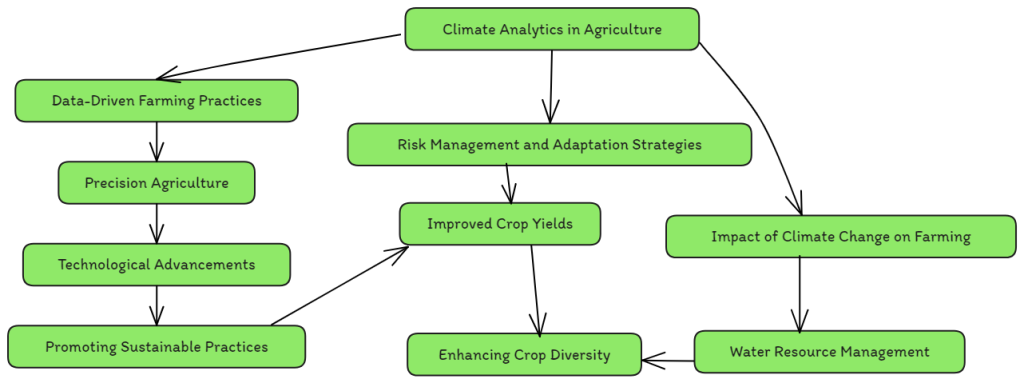
The diagram “Transforming Agriculture with Climate Analytics” encapsulates the pivotal role of climate analytics in modern agriculture. As climate change increasingly impacts farming practices, the adoption of climate analytics becomes crucial. It aids in understanding the effects of climate change on farming, leading to the development of data-driven farming practices that enhance precision agriculture. This shift promotes sustainable practices, including water resource management and enhancing crop diversity, which are essential for managing risks and adapting to changing environmental conditions. Technological advancements play a significant role in this transformation, leading to improved crop yields and a more sustainable agricultural landscape. The integration of climate analytics into agriculture marks a significant step towards ensuring food security and sustainability in the face of global climate challenges.
Climate Analytics at Work: Case Studies and Success Stories
Precision Agriculture: Leveraging Satellite IoT for Enhanced Farming
The integration of satellite IoT (Internet of Things) technologies is revolutionizing precision agriculture by overcoming challenges like cellular connectivity in remote areas. Utilizing Low Earth Orbit (LEO) satellites, these technologies deliver essential smart data for precision agriculture at an affordable cost. This includes location tracking and messaging necessary for efficient farm management, significantly enhancing productivity and cost savings. For instance, asset trackers on vehicles and equipment provide precise GPS coordinates, facilitating real-time tracking and management of farm assets, from livestock to machinery. The use of “smart collars” on cattle is a notable example, allowing farmers to monitor animal movements and health, which is crucial for minimizing loss and improving yields. The broader impact of IoT satellite solutions in agriculture encompasses real-time data collection, geofencing for herd and equipment safety, and need-based maintenance scheduling, among others. A study by Purdue University highlighted that the adoption of precision agriculture technology has led to an average net benefit of almost $90 per acre for farmers, showcasing the tangible benefits of integrating these technologies into farming practices.
Enhancing Crop Management and Sustainability through IoT
The application of IoT in agriculture extends beyond connectivity solutions, embracing a nature-positive approach to farming. Variable-rate seeding, empowered by advanced sensing and communications technology, significantly boosts crop yield per acre while optimizing resource efficiency. Tractors equipped with IoT technologies can control planting depth and spacing, enhancing growth conditions for various crops. This precision in planting and resource application reduces waste and ensures more sustainable farming practices. Furthermore, automated water delivery systems, informed by weather and soil sensor data, optimize irrigation, conserving water and improving soil moisture content. These technological advancements not only support more efficient farming operations but also contribute to environmental sustainability by reducing the use of water, fertilizers, and fossil fuels.
IoT and Precision Agronomics: A Synergy for Future Farming
Precision agriculture, driven by IoT and technology, is set to grow to $43.4 billion by 2025, reflecting its increasing importance in modern farming. The core of precision agriculture involves making farming practices more accurate and controlled, from crop growing to livestock raising. This is achieved through a myriad of technologies, including GPS guidance, control systems, sensors, drones, and automated hardware. The adoption of these technologies facilitates efficient farm management, reducing waste and enhancing productivity. GPS soil sampling and variable rate technology (VRT) are key components, enabling precise application of inputs like seeds and fertilizers based on soil conditions and crop needs. Remote sensing technology further enriches decision-making by providing detailed insights into crop health and soil moisture levels. As precision agriculture continues to evolve, it promises not only greater efficiency and productivity for farmers but also a more sustainable approach to farming that benefits the environment.
These case studies and technological advancements highlight the transformative impact of climate analytics and IoT technologies in agriculture. By adopting these innovations, farmers can significantly improve their operations’ efficiency, sustainability, and resilience against climate variability.
How to Integrate Climate Analytics into Your Farming Practice
Getting Started with Climate Analytics
Integrating climate analytics into your farming operations begins with understanding the basics of climate data and how it can impact your agricultural practices. The first step is to assess your farm’s specific needs and challenges that could be addressed through climate analytics. This could involve identifying areas where crop yields have been inconsistent or where water resources have been insufficient. Once you have pinpointed these areas, the next step is to familiarize yourself with the types of climate data available, such as temperature trends, rainfall patterns, and seasonal forecasts. This foundational knowledge will guide you in selecting the appropriate tools and technologies that can leverage this data for your farm’s benefit.
Selecting the Right Tools and Technologies
Choosing the right climate analytics tools and technologies is crucial for maximizing their benefits on your farm. There is a wide array of options available, each suited to different aspects of farming and levels of technological integration. For smaller operations, simple weather tracking apps and basic soil moisture sensors might suffice. Larger farms or those looking to implement more sophisticated strategies might consider satellite imagery services for detailed crop health monitoring or advanced irrigation management systems that adjust water delivery based on real-time climate data. When selecting these tools, consider factors like cost, ease of use, compatibility with your existing systems, and the level of customer support provided.
Implementing Data-Driven Decision Making
The ultimate goal of integrating climate analytics into your farming practice is to enable data-driven decision making. This means using the insights gained from climate data to inform every aspect of your farm management, from when to plant and harvest to how to allocate resources most efficiently. Start small by implementing changes based on clear trends and gradually expand as you become more comfortable interpreting and acting on the data. Regularly review the outcomes of your decisions to refine your approach. Over time, you will develop a more resilient and productive farming operation that is better equipped to adapt to the challenges posed by climate variability.
Five Revolutionary Climate Analytics Tools Transforming Agriculture
1. Satellite Imagery and Remote Sensing
Satellite imagery and remote sensing technologies have become indispensable tools in modern agriculture, providing farmers with detailed insights into crop health, soil moisture levels, and even pest infestations. These tools use data collected from satellites to monitor changes over time, enabling farmers to identify issues early and take corrective action. The precision and scope of satellite imagery make it possible to manage vast tracts of land efficiently, optimizing inputs and maximizing yields.
2. Weather Prediction Models
Advanced weather prediction models offer localized climate predictions with high accuracy, allowing farmers to plan better and mitigate risks associated with weather variability. These models analyze vast amounts of data to forecast weather conditions days, weeks, or even months in advance. By integrating these forecasts into their planning, farmers can choose the best planting and harvesting times, manage irrigation more effectively, and prepare for extreme weather events.
3. Soil Moisture Sensors and Drones
Soil moisture sensors and drones are at the forefront of precision agriculture, offering real-time data on soil conditions and crop health. Soil moisture sensors provide valuable information on when and where irrigation is needed, preventing water waste and ensuring crops receive optimal moisture. Drones equipped with high-resolution cameras and sensors can survey large areas quickly, identifying problem spots that require attention. Together, these technologies enable a level of monitoring and management that was previously unimaginable.
4. AI and Machine Learning Platforms
AI and machine learning platforms are transforming agriculture by analyzing data from various sources to predict crop yields, optimize farm operations, and enhance decision-making processes. These platforms can process information from weather forecasts, satellite imagery, soil sensors, and more, learning patterns and providing insights that help farmers increase efficiency and productivity. As these technologies continue to evolve, they will play an increasingly vital role in helping farms adapt to changing conditions and sustainably meet the growing global demand for food.
5. Blockchain for Climate Data Integrity
Blockchain technology ensures the reliability and security of climate data shared across the agricultural sector. By creating a decentralized and tamper-proof record of climate observations and transactions, blockchain enhances transparency and trust among farmers, researchers, and policymakers. This can facilitate more accurate and collaborative approaches to managing agricultural risks associated with climate change, promoting a more resilient and sustainable food system.
Leading Through Innovation: The Future of Farming with Climate Analytics
Advancing Beyond Traditional Farming
The advent of climate analytics marks a significant departure from traditional farming methods that relied heavily on intuition and historical patterns. This modern approach leverages data-driven insights to inform decisions, offering a more precise understanding of how climatic factors affect agricultural productivity. By integrating climate analytics, farmers are now equipped to optimize planting schedules, irrigation, and pest control with unprecedented accuracy. This leap forward not only increases yield and efficiency but also minimizes waste and environmental impact, heralding a new era of farming that is both more productive and sustainable.
Sustainability and Climate Resilience
Climate analytics plays a pivotal role in fostering sustainable farming practices and enhancing climate resilience. Through the use of predictive models and real-time data, farmers can anticipate adverse weather conditions and adjust their practices accordingly, reducing the risk of crop failure and loss of income. Moreover, climate analytics supports the adoption of practices that conserve water and soil health, contribute to carbon sequestration, and reduce greenhouse gas emissions. This approach not only ensures the long-term viability of farming operations but also contributes to broader environmental sustainability goals, helping to combat climate change and preserve biodiversity.
Vision for the Future
Looking ahead, the potential advancements in climate analytics promise to further transform agriculture and bolster global food security. Innovations such as enhanced predictive models, deeper integration of AI and machine learning, and more sophisticated sensor technologies will offer even greater precision in farming practices. These advancements will enable farmers to respond more effectively to the challenges posed by climate change, including extreme weather events, water scarcity, and shifting pest dynamics. As climate analytics continues to evolve, its role in ensuring the sustainability and resilience of global food systems will become increasingly critical, offering hope for a future where agriculture thrives in harmony with the planet.
FAQs: Climate Analytics in Agriculture
How do I start integrating climate analytics into my farming operations?
Begin by identifying specific challenges on your farm that could be addressed with climate data, such as water usage or pest management. Then, explore basic climate analytics tools like weather tracking apps and simple sensors to get familiar with using data in your decision-making processes.
What is the investment required for climate analytics, and what returns can I expect?
The cost varies widely depending on the scale and sophistication of the technology implemented. While initial investments can be significant, the return on investment (ROI) can be realized through increased yields, reduced input costs, and improved resource efficiency. Many farmers find that the benefits far outweigh the costs over time.
What are common challenges in adopting climate analytics, and how can I overcome them?
Common challenges include the cost of technology, the complexity of data analysis, and the need for technical expertise. Overcoming these challenges may involve starting small, seeking out training and support, and gradually scaling up as you become more comfortable with the technologies.
How can I stay updated on the latest developments in climate analytics for farming?
Engage with agricultural technology communities online, attend industry conferences, and subscribe to relevant publications. Staying connected with the agtech community will help you stay informed about new tools and best practices.
Conclusion: Embracing Change for a Sustainable Future
The integration of climate analytics into farming represents a pivotal shift towards more sustainable and resilient agricultural practices. By leveraging data-driven insights, farmers can make informed decisions that optimize productivity while minimizing environmental impact. The advancements in technology and analytics not only promise to enhance farm efficiency and yields but also play a crucial role in addressing global challenges such as climate change and food security. As we look to the future, it is clear that embracing climate analytics is not just an option but a necessity for ensuring a sustainable, productive future for agriculture worldwide.