
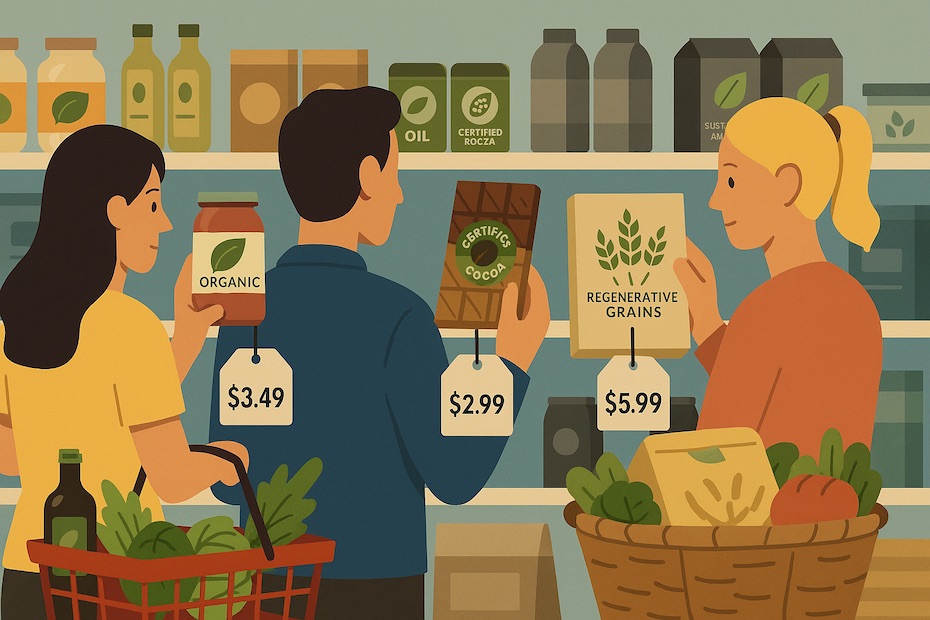
Yes, consumers are willing to pay more for sustainable food—if the value, transparency, and authenticity behind the product align with their personal beliefs and budgets.
This article gives you clear answers backed by real-time behavior, purchase patterns, and market trends. You’ll see what actually drives willingness to pay, where premium pricing works, and how to position sustainably produced food to succeed in the current marketplace.
What motivates consumers to choose sustainable food?
Consumers choose sustainable food when it aligns with health, environmental, or ethical values—and when trust and transparency are built into the brand.
You’re not just selling a product; you’re selling peace of mind. Surveys from McKinsey and Nielsen consistently show that top motivations include health safety, environmental protection, and support for ethical labor. But none of that translates into dollars unless the value is clearly communicated and accessible.
Trust is the most underrated variable. According to Edelman’s Trust Barometer, 64% of consumers say brand trust significantly influences purchase decisions. You need to clearly show certifications, ingredient sourcing, and company mission. Authentic storytelling isn’t just branding—it’s the lever that allows price elasticity to function.
How much more are consumers willing to pay?
Most consumers are willing to pay 5–20% more for food labeled as sustainable, depending on category and demographic.
In a 2024 GlobeScan survey across 27 countries, 60% of consumers said they are “very willing” to pay more for food products that are sustainably sourced. That willingness, however, varies. Staples like rice and oil rarely get more than a 5–10% premium. High-trust items like plant-based proteins, organic snacks, and eco-certified seafood can command up to 20% more.
Gen Z and millennials are leading this behavior. A survey by First Insight and the Wharton School showed that 73% of Gen Z and 68% of millennials will pay more for sustainability, compared to 51% of Gen X and 33% of baby boomers. For brands, this generational divide is your strategic cue to segment pricing and marketing accordingly.
Which types of sustainable food sell best at a premium?
Products with third-party certifications, transparent sourcing, and added health benefits see the highest price tolerance from consumers.
The market has validated premium pricing in categories like fair trade chocolate, grass-fed dairy, pasture-raised eggs, and carbon-neutral coffee. These succeed because their sustainability story connects with a tangible benefit—be it better taste, fewer pesticides, or fair labor.
Health halo matters. Products that combine sustainability with perceived health benefits—low sugar, gluten-free, or additive-free—gain faster traction at a higher price. For instance, sales of organic and non-GMO snacks have grown over 12% year-over-year in North America, even while inflation pressured other grocery categories.
What role do labels and certifications play?
Labels act as the proxy for trust and are critical to validating higher pricing for sustainable food.
A 2023 Consumer Goods Forum study showed that food products with visible eco-labels had 32% higher purchase intent than similar unlabeled items. Certifications like USDA Organic, Fair Trade, Rainforest Alliance, or CarbonNeutral not only drive credibility but also simplify the decision-making process.
But be cautious: overload or greenwashing leads to distrust. Less is more when it comes to packaging claims. A single, recognized, third-party label backed by traceable data performs far better than a cluster of ambiguous self-made icons.
How should you price sustainable food to attract real buyers?
You need to anchor pricing in perceived value, not just cost. Premiums only stick when you deliver and communicate clear, personal benefit.
Don’t assume that sustainability alone justifies a higher price. Consumers want to know what they’re gaining. Whether it’s better health, environmental contribution, or community support, connect it back to a tangible reason they’d pay more. Bundle that value into your communication and pricing structure.
Here’s how successful food brands are pricing and positioning sustainability:
- Link product benefits directly to consumer values (e.g., carbon footprint saved, worker wage supported).
- Use pricing tiers for entry-level vs. premium SKUs within the same product line.
- Offer limited editions or seasonal releases to reinforce exclusivity and scarcity.
- Display savings or positive impact in quantifiable units (e.g., “This pack saved 10 liters of water”).
- Integrate loyalty incentives around sustainable choices (e.g., points for choosing local or carbon-reduced items).
Why do some consumers resist paying more?
Price sensitivity, skepticism, and lack of clear information are the biggest barriers to paying extra for sustainable food.
Even among willing buyers, there’s a ceiling. If the perceived benefit doesn’t exceed the premium, most consumers walk away. Inflation has only heightened this behavior. A 2024 Mintel report showed that over 45% of U.S. consumers stopped buying certain sustainable products in the past 12 months due to cost concerns.
Skepticism also plays a role. Consumers often question whether “sustainable” means anything real. This is why brands must show receipts—whether that’s a farm video, audit trail, or verifiable certification link. Without proof, your sustainable positioning collapses at shelf level.
How can food brands successfully justify higher prices?
Focus on impact transparency, ingredient integrity, and relatable storytelling that aligns with consumer identity.
When the product experience reinforces the story—better flavor, visible freshness, recognizable sourcing—customers accept a higher price. You don’t need to be luxury to justify a markup, but you do need to be honest and specific.
Brands like Patagonia Provisions and Alter Eco succeed because they show where their food comes from, how it supports ecosystems, and why it matters to the end user. They give their customers a mission they can participate in. That’s what unlocks loyalty beyond price comparison.
Are consumers really paying more for sustainable food?
- The benefit is personal (e.g., health, flavor)
- Labels and sourcing are verified
- The brand earns trust
- The premium stays under 20%
In Conclusion
You can charge more for sustainable food, but only if you align price with value, proof, and purpose. Consumers need more than buzzwords—they need clarity, trust, and benefits they care about. When those conditions are met, they’re not just willing to pay more—they’ll advocate for your brand.
For more ideas on sustainable living, ethical business, and market behavior, visit tumblr.